

How to Hire a Virtual Assistant in Indonesia (2026 Guide)
A guide to hiring a virtual assistant in Indonesia, using workers' asking salaries, profile checks, paid test tasks and questions to settle before work begins.
5 min read
Read moreIndonesian data workers build lead lists, keep a CRM clean, load product catalogues, turn PDFs into structured rows, run desk research, and clean or label data. This is volume work, so the first thing to agree is not the salary but how accuracy gets checked.
Every profile shows unedited English writing and a self-reported level. ID-Verified badges show whose KTP has been checked.

Property Marketing | Data Entry | Microsoft Office & Canva
One of my proudest achievements is selling many houses since I started working in property marketing in 2015.
Annotation/labelingCRM data entryData cleaningLead list building+8

Data Entry | Document Formatting | Transcriptioner
One of my proudest work experiences was working as an Account Officer at PNM Mekaar.
Data entryLead list buildingMicrosoft OfficePDF conversion+1

Data Entry & Administrative Support Specialist
I like to organize and check documents, manage data.
Data cleaningExcel/Google Sheets (advanced)Inventory managementInvoicing+6

Administrative Assistant | Data Entry | Microsoft Excel
I am proud of my ability to organize data, prepare documents, and complete administrative tasks carefully.
CRM data entryData cleaningLead list buildingMarket research+2

Data Entry & Research Spesialist | Accurate & Detail - Oriented
At my previous job in a phone shop, I managed all product data and fixed messy records.
CRM data entryData cleaningPDF conversionProduct data entry

Data Entry & Metadata Specialist | Accurate and Detail-Oriented
I am proud of completing data entry and metadata projects with high accuracy.
Data cleaningPDF conversionProduct data entry
Most of this work has the same shape: a source, a destination, and a rule for what counts as correct. Say which of these you need and how much of it there is, in rows or in hours a week.

Tools they already use: Excel · Google Sheets · Airtable · HubSpot · Notion · Web scrapers
Put a number in the job post. "About 4,000 product rows a month into Shopify, from supplier PDFs" tells a worker whether they can do it and tells you who has done it before. "Detail-oriented data entry" tells neither of you anything.
Volume work fails quietly. Nobody tells you that 3 percent of the rows are wrong; you find out when a campaign bounces or a customer is shown the wrong price. Agree the check before the first batch, not after the first mistake.
Spot-checking earns its keep in the first 30 days with a new hire. After that it is maintenance.
This is the honest question about data work, and the answer is not that nothing has changed. Optical character recognition reads a clean PDF well. A language model will standardise addresses, split a name field, and draft a first pass at categorising products. If your work really is one clean source into one clean destination, script it and hire nobody.
What is left is the part with judgement in it. Deciding whether two records are the same company. Reading a scanned invoice that a model reads confidently and wrongly. Checking that a lead is a real business with a real person at it. Noticing that a supplier changed their column order last month. Writing the rulebook the automation then follows.
Most workers on this page already use these tools and are faster for it. Ask what they automate and what they check by hand. Someone who says they run a model over the batch and then verify a sample is describing the job accurately. Someone who says they never touch AI on data work is either slower than they need to be or not telling you the whole thing.
Workers set their own expected salary and every profile shows it in USD and IDR before you reach out. The left column is what this work is agreed at, by level and by arrangement. The figures beside it are what the live profiles in this role are asking today.
This is the most price-sensitive role on the site and the ceiling is real: nothing in the live asks beside this sits above $800 a month. What moves a number up is research judgement and tool depth, not typing speed. Per-record pricing suits a one-off batch, but only agree a per-record price after a sample has shown you both how long a record actually takes.
$397/mo median
Expected monthly salary across the 150 live profiles in this role that state one.
Data work is the role where the English level matters least and the written instructions matter most. What you need is someone who reads a spec closely and asks about the edge case before processing four thousand rows the wrong way. Indonesia's national average sits in the moderate band, below the Philippines, and it says nothing about the person you shortlist. Read the unedited writing on the profile, then judge the questions they ask about your sample batch. Silence on a fifty-row sample is the warning sign, not imperfect grammar.
Most workers are on Jakarta time (UTC+7), 6 to 7 hours ahead of London and 11 to 12 ahead of New York. Batch work is the best possible fit for that offset: you hand over at the end of your day and the finished sheet is waiting in the morning. Agree a delivery time rather than working hours, and keep one short call a week for the questions that pile up. Real overlap only becomes necessary when the output feeds something time-critical, like a list that has to be ready before a send.
5 shared hours
Ask for a fifty-row sample before the full batch, write down what to do with the awkward cases, then spot-check a percentage of finished rows that you pick yourself. Ten percent while the work is new and two or three percent once it is steady is a normal shape. Agree an error threshold in the same conversation, because "accurate" with no number attached is an argument waiting to happen.
Monthly salary for ongoing work, hourly for unpredictable overflow, per record only for a defined one-off batch. Per-record pricing looks precise and often is not: until a sample tells you both how long a record takes, one of you is guessing and the other is going to be unhappy. Run the sample, time it, then price it. Part-time data work commonly runs $5 to $9 an hour here.
It has removed some of the work and left the harder part. Clean PDF to spreadsheet is largely a solved problem, and if that is your whole job you should script it. What still needs a person is judgement: whether two records are the same company, whether a scanned invoice was read correctly, whether a lead is a real business, and what to do when a source changes shape. Ask a candidate what they automate and what they verify by hand. The good answer includes both.
Ask how they verify, because that is the whole difference. A worker who runs found addresses through a verification tool, checks the pattern against the company domain, and marks the uncertain ones instead of shipping them will hand you a list you can send to. Give them your ideal customer criteria in writing and ask for the first 50 rows before the first 1,000.
Workers set their own expected salary and you pay them directly, with no agency markup and no take-rate. Entry-level data entry and list building is commonly agreed between $200 and $400 a month, experienced workers who run a process $400 to $600, and research or annotation work with real judgement in it $500 to $800. The salary module above counts what the live profiles in this role are asking and shows the current median, and every profile shows its own figure in USD and IDR.
Most are comfortable in Excel and Google Sheets first, and in Airtable, a CRM such as HubSpot, and whatever admin panel your store or PIM uses. Each profile lists the tools that worker has used. Give read-only or restricted access where you can, and set up the account before the first day rather than during it.
You hire directly. Browsing profiles and reading applications is free. Messaging is the only paid feature: $49 a month, flat, with 75 new contacts a month, cancel anytime, and a 30-day money-back guarantee. There is no cut of the salary and the working relationship is yours.
Wise is the usual sending rail, at about 1 percent and often minutes to arrive; Payoneer is the usual receiving option at about 2 percent. Avoid international wires for monthly salaries, which can cost $70 to $100 per transfer. If you are paying per batch rather than monthly, agree what triggers payment, normally delivery plus your spot-check, and write it down.
Profiles carry a trust tier: New, Verified, or ID-Verified, where the worker has confirmed their identity against their government ID (KTP). The tier is shown on every profile and in search, so you can see it before you reach out.
A guide to hiring a virtual assistant in Indonesia, using workers' asking salaries, profile checks, paid test tasks and questions to settle before work begins.
5 min read
Read more
People quit in month two because month one was chaos. A week-by-week plan for onboarding an Indonesian remote hire, with the local details built in.
6 min read
Read more
What Indonesian virtual assistants ask for per month in 2026, split by full-time, part-time and project work, from the asking salaries on live OnlineJobs Indonesia profiles.
5 min read
Read more
Many do, and the level varies a lot. EF's 2025 index, the English levels workers state on our profiles, and how to check one person before you hire.
6 min read
Read more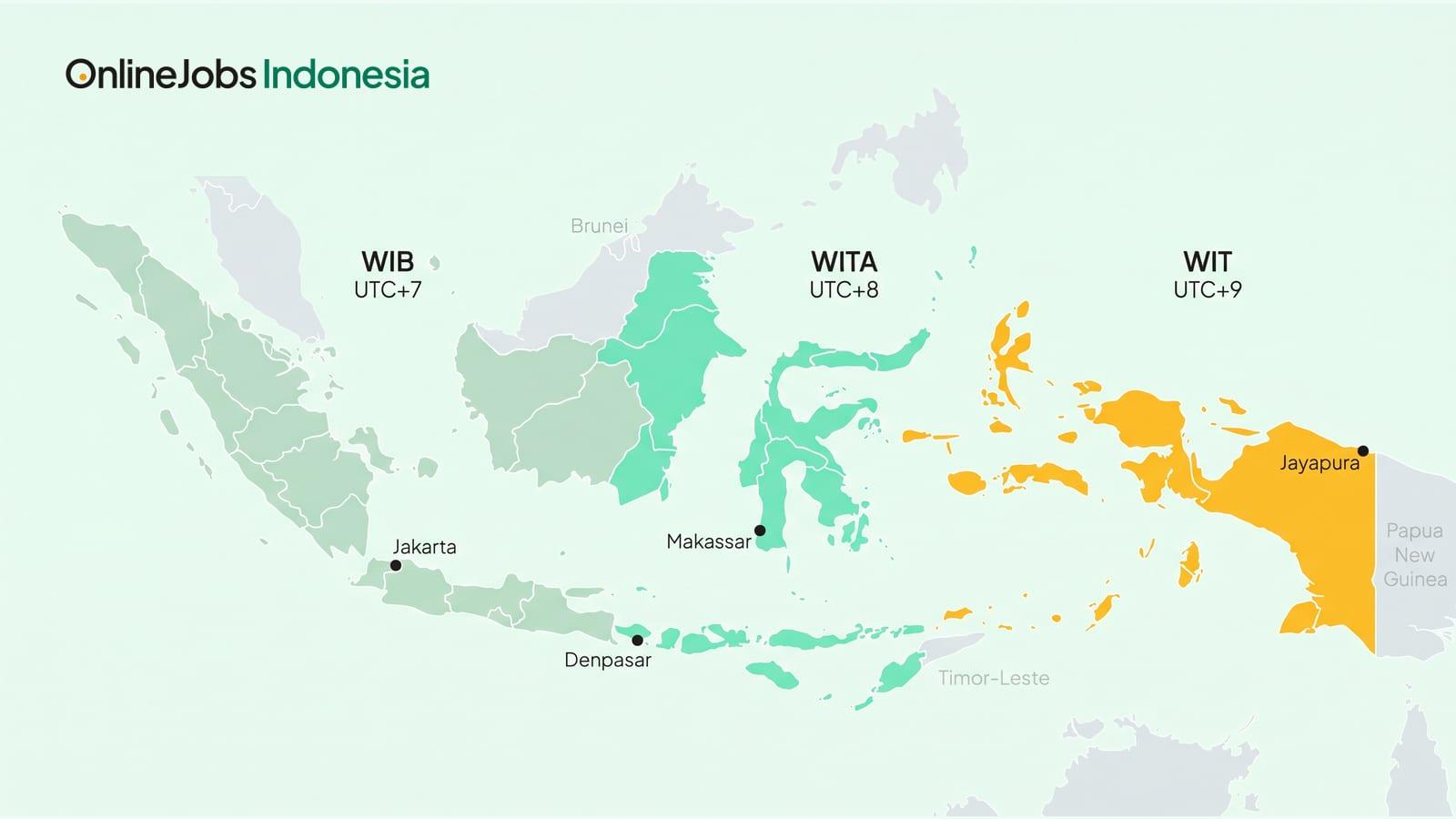
Indonesia is UTC+7 and does not use daylight saving. Here is the real overlap with the US, UK, Europe and Australia, and what full US hours cost.
7 min read
Read moreBrowse workers free, then subscribe only when you want to message them. Cancel after you hire.